DELIVERY & GIFT DETAILS:
Usually ships within 24 hours
Delivery Time and Shipping Rates
Eligible for gift wrap & gift message.

Reserve it at BN.com & pick it up in 60 minutes at your local store.
Enter a zip code
(Paperback - Reprint)
Reader Rating: (301 ratings)
Detailed Rating: "Originality" See All
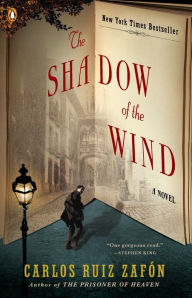
The wildly popular gothic novel- now in a stunning new package
"A secret's worth depends on the people from whom it must be kept," begins Carlos Ruiz Zafón's astounding novel of postwar Barcelona. But more than four years after its initial paperback publication, the secret is out-the novel remains a favorite of booksellers and readers alike.
The melodrama and complications of Shadow, expertly translated by Lucia Graves, can approach excess, though it's a pleasurable and exceedingly well-managed excess. We are taken on a wild ride -- for a ride, we may occasionally feel -- that executes its hairpin bends with breathtaking lurches. Richard Eder
More Reviews and RecommendationsWhile Carlos Ruiz Zafón was first known for his books for young adults -- his El príncipe de la niebla (The Prince of Mist) earned the Edebé literary prize for young adult fiction in 1993 -- his first "adult" novel La sombra del viento (The Shadow of the Wind) garnered acclaim around the world and sparked what the author calls in our interview, a kind of “Zafón-mania."
More About the AuthorReader Rating:
See Detailed Ratings
November 15, 2009: This book is absolutely stunning. An engrossing story that is beautifully written (and/or translated,) with characters that you can't help but feel for, along with a breathtaking depiction of historic Barcelona, this touching and insightful gem is soon to be an instant classic. "The Shadow of the Wind" is storytelling at its finest.
Reader Rating:
See Detailed Ratings
November 15, 2009: Characters were developed to the point that you "knew" them. I am so glad this book was made available to us in the United States. My thanks to the translators.
Name:
Carlos Ruiz Zafón
Current Home:
Barcelona, Spain
Date of Birth:
September 25, 1964
Place of Birth:
Barcelona, Spain
Awards:
Winner of the Edebe Literary Award for best novel, 1993; Best Book of the Year, as voted by readers of the Barcelona newspaper La Vanguardia, 2003 ; Book Sense Book of the Year Honor, 2005
Carlos Ruiz Zafón was born in Barcelona in 1964 and began his publishing career by writing novels for young adults. In 1993, he won the Edebé Children's Literature Award for his first book, El príncipe de la niebla. His debut in adult fiction, The Shadow of the Wind, spent more than a year on the Spanish bestseller list, much of the time at No. 1, and has been published in more than 20 countries.
The author currently lives in Los Angeles.
Author biography courtesly of Penguin Group USA.
Some interesting outtakes from our interview with Zafón:
"In my tender youth I worked as a musician (composer, arranger and keyboard player/synthesizer programmer, record producer, etc.) and I've also labored for seven long years in the advertising jungle as a cynical mercenary, first as a copywriter, then a creative director (whatever that means) and also producing/directing TV commercials and polluting the world with artifacts glorifying Visa, Audi, Sony, Volkswagen, American Express, and many other evil entities. In 1992, when the lease on my soul was about to expire, I quit to become what I always wanted to do, be a full-time writer. Since then, I've published five novels and also have worked occasionally as a screenwriter."
"I am a curious creature and put my finger in as many cakes as I can: history, film, technology, etc. I'm also a freak for urban history, particularly Barcelona, Paris and New York. I know more weird stuff about 19th-century Manhattan than is probably healthy."
There are two things that I cannot live without: music and books. Caffeine isn't dignified enough to qualify."
Who are the authors most influenced your life, or your career as a writer?
Charles Dickens and all of the 19th-century giants.
What are some of your favorite films, and what makes them unforgettable to you?
Citizen Kane, Blade Runner and the Godfather trilogy. My work as a screenwriter has influenced my fiction. Writing screenplays forces you to consider many elements regarding story structure and other narrative devices that can be used to enhance the infinitely more complex demands of a novel. I believe the modern novel should try to recapture the great scope and ambition of the 19th century classics, but infusing it with all the narrative tools the 20th century has left us, from the avant-garde to, why not, the syntax of images and sounds of the golden screen.
What types of music do you like? Is there any particular kind you like to listen to when you're writing?
Classical. My own music. I carry around a fully loaded 30-gigabyte iPod with everything from Bach to obscure electronic stuff in it, and I have thousands of CDs at home. Music is my drug of choice.
If you had a book club, what would it be reading?
I'm a voracious reader, and I life to explore all sorts of writing without prejudice and without paying any attention to labels, conventions or silly critical fads. I think I learn a little from everything I read, from genre fiction to the classics. If I had to choose a particular pantheon, though, I'd say the great 19th-century giants have yet to be beat or even remotely approached. Dickens, Tolstoy, Dostoyevsky, Balzac, Hugo, Hardy, Dumas, Flaubert. When in doubt, go to the classics.
Do you have any special writing rituals? For example, what do you have on your desk when you're writing?
I am a night creature, and I write from midnight till dawn, secluded in my office and surrounded by my collection of dragons (I have 400 of them). I only use Macintosh computers, which I name in dynastic order. Right now I'm using MacDragon 5. Only the devil is able to decipher my handwriting.
What are you working on now?
I'm working on a new novel that picks up the mix of genres and techniques of The Shadow of the Wind and tries to take it to the next level. It is the second part of a cycle of four books that I have planned in this "gothic Barcelona quartet" -- a sort of narrative kaleidoscope of Victorian sagas, intrigue, romance, comedy, mystery, and "newly" fashioned old-fashioned good storytelling.
Many writers are hardly "overnight success" stories. How long did it take for you to get where you are today? Any rejection-slip horror stories or inspirational anecdotes?
The Shadow of the Wind is my fifth novel published without "labels" after four successful young adult novels. Since it was first published in 2001, it has become a publishing and cultural phenomenon. After early praise by many critics, it became a cult classic that has been growing over two years by word-of-mouth, by the enthusiastic recommendation of booksellers, reviewers and above all readers who after discovering the novel would buy several copies to give to their loved ones. Interestingly, the novel seems to create an emotional and intellectual attachment with the reader, who, very much like the narrator in the novel, becomes its "protector." It's been ages since the literary market in Spain had seen this kind of intense response to a book (although some of my early young adult novels have elicited a similar response among younger readers), and many in the industry have begun to talk about the "Zafón-mania". Today, in its third year, The Shadow of the Wind still commands the bestseller lists, and shows no signs of slowing down.
Barnes & Noble Discover Great New Writers
In the postwar calm of 1945 Barcelona, ten-year-old Daniel Sempere awakes from a nightmare and, to his horror, realizes that he can no longer remember the face of his deceased mother. In an effort to divert his son's attention from this sharply felt fear and loss, his father, a rare-book dealer, first swears Daniel to secrecy, then takes him to a clandestine library where Daniel is allowed to select a single book.
Entranced, Daniel picks a novel, The Shadow of the Wind, written by the enigmatic Julián Carax, who is rumored to have fled Spain under murky circumstances, and later died. As Daniel begins to search for other works by his favorite new author, he discovers that they have all been destroyed -- torched by a mysterious stranger obsessed with obliterating Carax's literary legacy from the face of the earth.
Though Daniel's copy of Carax's novel is the last in existence, he's unwilling to part with it at any price and dedicates himself to revealing the truth about Carax. Aided in his quest by the good-humored Fermín Romero de Torres, a former beggar whose "difficult life-lessons" enable him to keep a step ahead of trouble, Daniel begins to uncover a tale of murder, madness, and secrets that might best be forgotten. And as he wends his way through Barcelona society, both high and low, he comes to realize that his own part in The Shadow of the Wind is more than that of a mere reader.
Also available en español! (Summer 2004 Selection)
The wildly popular gothic novel- now in a stunning new package
"A secret's worth depends on the people from whom it must be kept," begins Carlos Ruiz Zafón's astounding novel of postwar Barcelona. But more than four years after its initial paperback publication, the secret is out-the novel remains a favorite of booksellers and readers alike.
The melodrama and complications of Shadow, expertly translated by Lucia Graves, can approach excess, though it's a pleasurable and exceedingly well-managed excess. We are taken on a wild ride -- for a ride, we may occasionally feel -- that executes its hairpin bends with breathtaking lurches. Richard Eder
… anyone who enjoys novels that are scary, erotic, touching, tragic and thrilling should rush right out to the nearest bookstore and pick up The Shadow of the Wind. Really, you should. Michael Dirda
The publishing phenomenon of the last year and a half.
Zafonmania... A thriller, a historical novel and a comedy of manners, but above all, the story of a tragic love...with great narrative skill, the author interweaves his plots and enigmas, like a set of Russian dolls in an unforgettable story about the secrets of the heart and the enchantment of books, maintaining the suspense right to the very last page.
As magnetic as The Dumas Club, as unsettling as The Mystery of the Haunted Crypt and with a plot as complex and well rounded as The Name of The Rose-to be recommended one hundred percent.
I was enthralled by Zafon's book and it gave me many hours of great delight. Not only because the story is set in a book shop, not only because it is about the search and the hunt for books and there is a library of forgotten books to be discovered, but because The Shadow of the Wind is suspenseful like a thriller, poetic like a love story, sometimes mysterious like its title, and because it describes the characters and the storyline so wonderfully that the reader wants to be a part of it. A paean to reading and to the love of books.
What a magnificent labyrinth a book can be... the Spanish author keeps us at it with his intense narrative style and delivers to the full what one would call a wonderfully good read... Already one talks of Zafonmania. Now it is your turn.
Ruiz Zafon's novel, a bestseller in his native Spain, takes the satanic touches from Angel Heart and stirs them into a bookish intrigue la Foucault's Pendulum. The time is the 1950s; the place, Barcelona. Daniel Sempere, the son of a widowed bookstore owner, is 10 when he discovers a novel, The Shadow of the Wind, by Juli n Carax. The novel is rare, the author obscure, and rumors tell of a horribly disfigured man who has been burning every copy he can find of Carax's novels. The man calls himself Lain Coubert-the name of the devil in one of Carax's novels. As he grows up, Daniel's fascination with the mysterious Carax links him to a blind femme fatale with a "porcelain gaze," Clara Barcelo; another fan, a leftist jack-of-all-trades, Fermin Romero de Torres; his best friend's sister, the delectable Beatriz Aguilar; and, as he begins investigating the life and death of Carax, a cast of characters with secrets to hide. Officially, Carax's dead body was dumped in an alley in 1936. But discrepancies in this story surface. Meanwhile, Daniel and Fermin are being harried by a sadistic policeman, Carax's childhood friend. As Daniel's quest continues, frightening parallels between his own life and Carax's begin to emerge. Ruiz Zafon strives for a literary tone, and no scene goes by without its complement of florid, cute and inexact similes and metaphors (snow is "God's dandruff"; servants obey orders with "the efficiency and submissiveness of a body of well-trained insects"). Yet the colorful cast of characters, the gothic turns and the straining for effect only give the book the feel of para-literature or the Hollywood version of a great 19th-century novel. (Apr. 12) Forecast: Appealing packaging (a weathered, antique-look jacket), prepublication bookseller events and an eight-city author tour should give this an early boost, though momentum may flag down the stretch. Copyright 2004 Reed Business Information.
This complex, Byzantine, at times longwinded work, which spent more than 60 weeks on Spain's best sellers list, throws together mystery, romance, and crime into one big mix like an olla podrida. Set in Franco's Spain, it revolves around the remarkably sophisticated 18-year-old Daniel Sempere. After visiting the Cemetery of Forgotten Books, which recalls Borges's labyrinthine Library of Babel, he decides to entrust to his care a tome by Julian Carax called The Shadow of the Wind. He soon discovers not only that he probably has the last extant copy of this work but that someone wants desperately to eradicate all the author's books and will resort to any means necessary, including murder. Daniel meets a wide range of well-developed yet eccentric characters as he wanders throughout Barcelona attempting to ascertain the truth. Zafon's fifth novel follows a traditional narrative; what is outstanding is the metaphysical concept of books that assume a life of their own as the author subtly plays with intertextual references (e.g., a pair of cockatoos named Ortega and Gasset make cameo appearances). Even the plot and characters of Carax's fictitious work are interwoven into this meticulously crafted mosaic. Recommended primarily for public libraries and especially for readers who lead double lives as bibliophiles. [Previewed in Prepub Alert, LJ 12/03.]-Lawrence Olszewski, OCLC Lib., Dublin, OH Copyright 2004 Reed Business Information.
The histories of a mysterious book and its enigmatic author are painstakingly disentangled in this yeasty Dickensian romance: a first novel by a Spanish novelist now living in the US. We meet its engaging narrator Daniel Sempere in 1945, when he's an 11-year-old boy brought by his father, a Barcelona rare-book dealer, to a secret library known as the Cemetery of Forgotten Books. Enthralled, Daniel "chooses" an obscure novel, The Shadow of the Wind, a complex quest tale whose author, Julian Carax, reputedly fled Spain at the outbreak of its Civil War, and later died in Paris. Carax and his book obsess Daniel for a decade, as he grows to manhood, falls in and out of fascination, if not love with three beguiling women, and comes ever closer to understanding who Carax was and how he was connected to the family of tyrannical Don Ricardo Aldaya-and why a sinister, "faceless" stranger who identifies himself as Carax's fictional creation ("demonic") "Lain Coubert" has seemingly "got out of the pages of a book so that he could burn it." Daniel's investigations are aided, and sometimes impeded, by a lively gallery of vividly evoked supporting characters. Prominent among them are secretive translator Nuria Monfort (who knows more about Carax's Paris years than she initially reveals); Aldaya family maid Jacinta Coronada, consigned to a lunatic asylum to conceal what she knows; Daniel's ebullient Sancho Panza Fermin Romero de Torres, a wily vagrant working as "bibliographic detective" in the Semperes' bookstore; and vengeful police inspector Fumero, a Javert-like stalker whose refusal to believe Carax is dead precipitates the climax-at which Daniel realizes he's much more than just a reader of Carax'sintricate, sorrowful story. The Shadow of the Wind will keep you up nights-and it'll be time well spent. Absolutely marvelous. Agent: Tom Colchie
Loading...Barnes & Noble.com: Biographic questions: Why and when did you move from Barcelona to Los Angeles? Are you planning to stay in the U.S.?
Carlos Ruiz Zafón: I came to L.A. in 1994. It was a time in my life when I needed to get far away from Barcelona, not just distance-wise but in my own mind. I think the experience proved very positive for me. Distance puts things in the right perspective and allows you to get a clearer picture, I think. Now I feel I've come full circle, and I am thinking it's time maybe to go back to my own Barcelona, although I plan to spend part of the year in America, which has also become my home.
B&N.com: The Shadow of the Wind was a finalist for the prestigious Fernando Lara Prize, though it didn't win, and then succeeded without promotional support, as a word-of-mouth phenomenon. From L.A., how did you react to your becoming a sort of Spanish Dan Brown?
CRZ: Well, seeing your work so generously embraced by the readers is the best possible reward a novelist could hope for, especially when the response is so sincere and spontaneous, based on the read and not on hype or grand marketing hooplas.
B&N.com: The Shadow of the Wind, the novel within the novel, changes the life of Daniel, the main character. Is there a book that has changed your life?
CRZ: I think that rather than a single book, what really changed my life was the discovery of reading, of storytelling, of the world of ideas and the boundless universe contained in books. Therefore, my own Shadow of the Wind is a book of books, of all books.
B&N.com: In many places, such as Spain and Latin America, there have been times when people could and did lose their lives because of a book. Did you think about this when you wrote The Shadow…?
CRZ: Yes, very much so. Unfortunately today, as in the past and probably in the future, many will lose their freedom or their lives because of their ideas or simply in the struggle to retain their own moral integrity against totalitarian fanaticism, bigotry, and intolerance of all sorts. I am very aware of that, particularly in the times we seem to be wandering into, where the future is every day more a dark reflection of the past.
B&N.com: There is talk of a movie based on The Shadow of the Wind: rumors about whether or not the rights are up for sale, speculation about whether it will be filmed in Hollywood or in Spain, and questions as to whether you, being both an author and screenwriter, would allow others to write the screenplay. What's your view? What would your choice be?
CRZ: Since I have some experience in this area, I am especially cautious regarding the possibility of a film adaptation. If it is to happen, it will be because I feel the right elements are brought together and I'm persuaded that the adventure is worth a try. But at any rate this is not a priority for me at all. I think it is good that novels stay novels, and that there's no need at all for everything to become a movie, a TV show, a video game, a kiddie meal, or a licensed toy of the month. Nothing can tell a story, convey a world, and render characters with the intensity, depth, and magic that literature allows. The Shadow of the Wind will be always first and foremost a book, and proudly so.
B&N.com: Before it was translated into English, your book was a success in the U.S. in Spanish. Your work contains echoes of the classic European tone, reflecting the darkness of urban life and of history. It has little to do with the Spanish-language literature that was initially promoted in America: stories (written by Latinos, curiously enough, though perhaps not wisely) about characters that are not typical of real people -- let alone of Latin American literature -- but rather reflect some misconceptions about Latino immigrants or Latin Americans. This trend seems to be declining. What's your opinion on this phenomenon, and what future do you forecast for Spanish-language literature in America?
CRZ: Good question. In fact, I've always regarded the kind of "literature in Spanish" that often has been promoted in America as quite peculiar, when not slightly condescending; as seen in the endless range of lively-colored covers tarting up the-magic-of-love-meets-zesty-cooking-saga that seems to operate under the assumption that an entire literature, from Cervantes to Borges -- one that spans centuries, continents, and radically different cultures -- were an ethnic novelty of sorts, riddled with silly clichés. I suppose that some marketing strategies -- or misconceptions -- have contributed to this. However, fads are, by default, doomed to fall out of fashion, and fast. However, the fate of literature in Spanish in America is in the hands of the Spanish-speaking, and -reading, peoples.
B&N.com: The Shadow... absorbs readers with a plot that does not need second readings -- it stands by itself. However, it also holds great fascination for those who enjoy books that talk about other books, bearing traces of and references to other authors (Borges, Mendoza, et al.), titles, genres, and literary prototypes. Would you tell us your top ten literary passions?
CRZ: I am a voracious reader, so it is hard for me to condense my literary passions and references into a shortlist. I try to read widely, without prejudice, with curiosity, and paying little or no attention whatsoever to "critical" fashion or the temporary fads of what is hot, cool, or tepid at any given time. I like mostly the great novelists of the 19th century, from Dickens to Flaubert to Tolstoy and all the giants. I like the modernist American writers from the early 20th century, such as John Dos Passos. I am interested in genre fiction, or what the snobs call para-literature, for I believe that that's where the most interesting writing of the past 25 years has been produced, away from the overhyped and underwritten wasteland of the literary mainstream and below the academic radar. I am interested in many elements of the visual grammar of film and multimedia, which I believe can enrich the narrative discourse of the future novel.... Mostly I tend to read nonfiction, especially history. But above all I like to discover new authors, new voices, no matter where they come from, paying zero attention to what is being peddled as fashionable or cool, which I always find to be the ultimate uncool.
B&N.com:Have you ever had the nightmare of becoming, like Julián Carax, an author of wonderful books that (almost) no one reads?
CRZ: I guess all writers fear their work will be forgotten, not to mention never discovered in the first place. Unfortunately, most of them are right. Literature is a cruel lover, and Lady Luck doesn't smile often on those who flirt with her.
B&N.com: Before The Shadow... you won awards and recognition for young-adult novels containing elements of mystery and romance. What's the difference between writing for younger readers and for adults? Why did you change?
CRZ: The switch came naturally because my years as a young-adult novelist were more of an accident than a vocation. My real narrative voice was never in that genre, and sooner or later I had to write what I had to write. That said, the difference isn't that significant. At the end of the day you've got to write with craft and sincerity and squeeze the best you've got into each page. I think that the differences between what is considered juvenile or adult fare are, most of the time, arbitrary. Ninety-nine percent of the current popular culture consumed by billions of adults around the world is strictly juvenile, and nobody seems to have a problem with that, or even notice. These things are just labels. And, as easily as they're attached, they're detached.
B&N.com: How's your next book evolving? What's it about?
CRZ: It is under construction, under wraps, and under state secrecy. All I can say is that is a novel along the lines of The Shadow of the Wind, a literary mystery once again set in my own gothic Barcelona...
B&N.com:Anything else that you'd like to share with your readers?
CRZ: I'd like to invite them to the adventure of reading, to take the leap beyond conventions and discover new authors and new books of which they never heard before, to develop their own criteria. To read is to live more, and live better. Life is short, so carpe diem, and carpe libri.
2. Nuria Monfort tells Daniel, "Julián once wrote that coincidences are the scars of fate. There are no coincidences, Daniel. We are the puppets of our unconscious." What does that mean? What does she refer to in her own experience and in Julián's life?
3. Nuria Monfort's dying words, meant for Julián, are, "There are worse prisons than words." What does she mean by this? What is she referring to?
4. There are many devil figures in the story-Carax's Laín Coubert, Jacinta's Zacarias, Fermín's Fumero. How does evil manifest itself in each devil figure? What are the characteristics of the villains/devils?
5. Discuss the title of the novel. What is "The Shadow of the Wind"? Where does Zafón refer to it and what does he use the image to illustrate?
6. Zafón's female characters are often enigmatic, otherworldly angels full of power and mystery. Clara the blind white goddess ultimately becomes a fallen angel; Carax credits sweet Bea with saving his and Daniel's lives; Daniel's mother is actually an angel whose death renders her so ephemeral that Daniel can't even remember her face. Do you think Zafón paints his female characters differently than his male characters? What do the women represent in Daniel's life? What might the Freud loving Miquel Moliner say about Daniel's relationships with women?
7. Daniel says of The Shadow of the Wind, "As it unfolded, the structure of the story began to remind me of one of those Russian dolls that contain innumerable ever-smaller dolls within" (p. 7). Zafón's The Shadow of the Wind unfolds much the same way, with many characters contributing fragments of their own stories in the first person point of view. What does Zafón illustrate with this method of storytelling? What do the individual mini-autobiographies contribute to the tale?
8. The evil Fumero is the only son of a ridiculed father and a superficial, status-seeking mother. The troubled Julián is the bastard son of a love-starved musical mother and an amorous, amoral businessman, though he was raised by a cuckolded hatmaker. Do you think their personalities are products of nature or nurture? How are the sins of the fathers and mothers visited upon each of the characters?
"It says here that this copy is part of an edition of twenty-five hundred printed in Barcelona by Cabestany Editores, in June 1936."
"Do you know the publishing house?"
"It closed down years ago. But, wait, this is not the original. The first edition came out in November 1935 but was printed in Paris....Published by Galiano & Neuval. Doesn't ring a bell."
"So is this a translation?"
"It doesn't say so. From what I can see, the text must be the original one."
"A book in Spanish, first published in France?"
"It's not that unusual, not in times like these," my father put in. "Perhaps Barceló can help us...."
Gustavo Barceló was an old colleague of my father's who now owned a cavernous establishment on Calle Fernando with a commanding position in the city's secondhand-book trade. Perpetually affixed to his mouth was an unlit pipe that impregnated his person with the aroma of a Persian market. He liked to describe himself as the last romantic, and he was not above claiming that a remote line in his ancestry led directly to Lord Byron himself. As if to prove this connection, Barceló fashioned his wardrobe in the style of a nineteenth-century dandy. His casual attire consisted of a cravat, white patent leather shoes, and a plain glass monocle that, according to malicious gossip, he did not remove even in the intimacy of the lavatory. Flights of fancy aside, the most significant relative in his lineage was his begetter, an industrialist who had become fabulously wealthy by questionable means at the end of the nineteenth century. According to my father, Gustavo Barceló was, technically speaking, loaded, and his palatial bookshop was more of a passion than a business. He loved books unreservedly, and-although he denied this categorically-if someone stepped into his bookshop and fell in love with a tome he could not afford, Barceló would lower its price, or even give it away, if he felt that the buyer was a serious reader and not an accidental browser. Barceló also boasted an elephantine memory allied to a pedantry that matched his demeanor and the sonority of his voice. If anyone knew about odd books, it was he. That afternoon, after closing the shop, my father suggested that we stroll along to the Els Quatre Gats, a café on Calle Montsió, where Barceló and his bibliophile knights of the round table gathered to discuss the finer points of decadent poets, dead languages, and neglected, moth-ridden masterpieces.
Els Quatre Gats was just a five-minute walk from our house and one of my favorite haunts. My parents had met there in 1932, and I attributed my one-way ticket into this world in part to the old café's charms. Stone dragons guarded a lamplit façade anchored in shadows. Inside, voices seemed shaded by the echoes of other times. Accountants, dreamers, and would-be geniuses shared tables with the specters of Pablo Picasso, Isaac Albéniz, Federico García Lorca, and Salvador Dalí. There any poor devil could pass for a historical figure for the price of a small coffee.
"Sempere, old man," proclaimed Barceló when he saw my father come in. "Hail the prodigal son. To what do we owe the honor?"
"You owe the honor to my son, Daniel, Don Gustavo. He's just made a discovery."
"Well, then, pray come and sit down with us, for we must celebrate this ephemeral event," he announced.
"Ephemeral?" I whispered to my father.
"Barceló can express himself only in frilly words," my father whispered back. "Don't say anything, or he'll get carried away."
The lesser members of the coterie made room for us in their circle, and Barceló, who enjoyed flaunting his generosity in public, insisted on treating us.
"How old is the lad?" inquired Barceló, inspecting me out of the corner of his eye.
"Almost eleven," I announced.
Barceló flashed a sly smile.
"In other words, ten. Don't add on any years, you rascal. Life will see to that without your help."
A few of his chums grumbled in assent. Barceló signaled to a waiter of such remarkable decrepitude that he looked as if he should be declared a national landmark.
"A cognac for my friend Sempere, from the good bottle, and a cinnamon milk shake for the young one-he's a growing boy. Ah, and bring us some bits of ham, but spare us the delicacies you brought us earlier, eh? If we fancy rubber, we'll call for Pirelli tires."
The waiter nodded and left, dragging his feet.
"I hate to bring up the subject," Barceló said, "but how can there be jobs? In this country nobody ever retires, not even after they're dead. Just look at El Cid. I tell you, we're a hopeless case."
He sucked on his cold pipe, eyes already scanning the book in my hands. Despite his pretentious façade and his verbosity, Barceló could smell good prey the way a wolf scents blood.
"Let me see," he said, feigning disinterest. "What have we here?"
I glanced at my father. He nodded approvingly. Without further ado, I handed Barceló the book. The bookseller greeted it with expert hands. His pianist's fingers quickly explored its texture, consistency, and condition. He located the page with the publication and printer's notices and studied it with Holmesian flair. The rest watched in silence, as if awaiting a miracle, or permission to breathe again.
"Carax. Interesting," he murmured in an inscrutable tone.
I held out my hand to recover the book. Barceló arched his eyebrows but gave it back with an icy smile.
"Where did you find it, young man?"
"It's a secret," I answered, knowing that my father would be smiling to himself. Barceló frowned and looked at my father. "Sempere, my dearest old friend, because it's you and because of the high esteem I hold you in, and in honor of the long and profound friendship that unites us like brothers, let's call it at forty duros, end of story."
"You'll have to discuss that with my son," my father pointed out. "The book is his."
Barceló granted me a wolfish smile. "What do you say, laddie? Forty duros isn't bad for a first sale....Sempere, this boy of yours will make a name for himself in the business."
The choir cheered his remark. Barceló gave me a triumphant look and pulled out his leather wallet. He ceremoniously counted out two hundred pesetas, which in those days was quite a fortune, and handed them to me. But I just shook my head. Barceló scowled.
"Dear boy, greed is most certainly an ugly, not to say mortal, sin. Be sensible. Call me crazy, but I'll raise that to sixty duros, and you can open a retirement fund. At your age you must start thinking of the future."
I shook my head again. Barceló shot a poisonous look at my father through his monocle.
"Don't look at me," said my father. "I'm only here as an escort."
Barceló sighed and peered at me closely.
"Let's see, junior. What is it you want?"
"What I want is to know who Julián Carax is and where I can find other books he's written."
Barceló chuckled and pocketed his wallet, reconsidering his adversary.
"Goodness, a scholar. Sempere, what do you feed the boy?"
The bookseller leaned toward me confidentially, and for a second I thought he betrayed a look of respect that had not been there a few moments earlier.
"We'll make a deal," he said. "Tomorrow, Sunday, in the afternoon, drop by the Ateneo library and ask for me. Bring your precious find with you so that I can examine it properly, and I'll tell you what I know about Julián Carax. Quid pro quo."
"Quid pro what?"
"Latin, young man. There's no such thing as dead languages, only dormant minds. Paraphrasing, it means that you can't get something for nothing, but since I like you, I'm going to do you a favor."
The man's oratory could kill flies in midair, but I suspected that if I wanted to find out anything about Julián Carax, I'd be well advised to stay on good terms with him. I proffered my most saintly smile in delight at his Latin outpourings.
"Remember, tomorrow, in the Ateneo," pronounced the bookseller. "But bring the book, or there's no deal."
"Fine."
Our conversation slowly merged into the murmuring of the other members of the coffee set. The discussion turned to some documents found in the basement of El Escorial that hinted at the possibility that Don Miguel de Cervantes had in fact been the nom de plume of a large, hairy lady of letters from Toledo. Barceló seemed distracted, not tempted to claim a share in the debate. He remained quiet, observing me from his fake monocle with a masked smile. Or perhaps he was only looking at the book I held in my hands.
loading...
loading...
loading...
Terms of Use, Copyright, and Privacy Policy
© 1997-2009 Barnesandnoble.com llc